
|
Getting your Trinity Audio player ready...
|
Standard Costing in Dynamics 365: An Executive Guide to Cost Governance and Margin Visibility
Introduction
For many organizations, cost is still managed through disconnected spreadsheets, local plant assumptions, and finance-led adjustments after the fact. That model is increasingly unsustainable. As supply chains grow more complex and margin pressure intensifies, leadership teams need a costing framework that is structured, explainable, and connected to operational execution.
That is where standard costing in Dynamics 365 becomes strategically important.
In Dynamics 365 Supply Chain Management and Finance, standard costing is more than an inventory valuation method. It is a governance model for defining expected cost, applying overhead logic consistently, controlling cost changes, and analyzing variances through both operational and financial lenses. Microsoft supports this through standard cost item model groups, costing versions, cost groups, costing sheets, variance configuration, and ledger integration.
Why standard costing matters to leadership teams
Standard costing gives executives a stable baseline for understanding what a product should cost before the noise of day-to-day transactions obscures the picture. Instead of relying only on historical actuals, organizations can define expected costs for purchased items, manufactured items, labor, machine time, and overhead, then measure operational performance against those expectations. Microsoft’s guidance makes clear that standard costing requires the use of activated cost records in a costing version, and the system uses those costs for inventory receipts and issues while posting variances to designated standard cost variance accounts.
This changes the conversation in the boardroom and at the plant level. Instead of asking why margins moved in general, leaders can ask whether the movement came from purchase price variance, production quantity variance, overhead absorption, engineering substitutions, or outdated standard assumptions. That level of precision is what separates reactive reporting from active cost governance.
What standard costing in Dynamics 365 includes
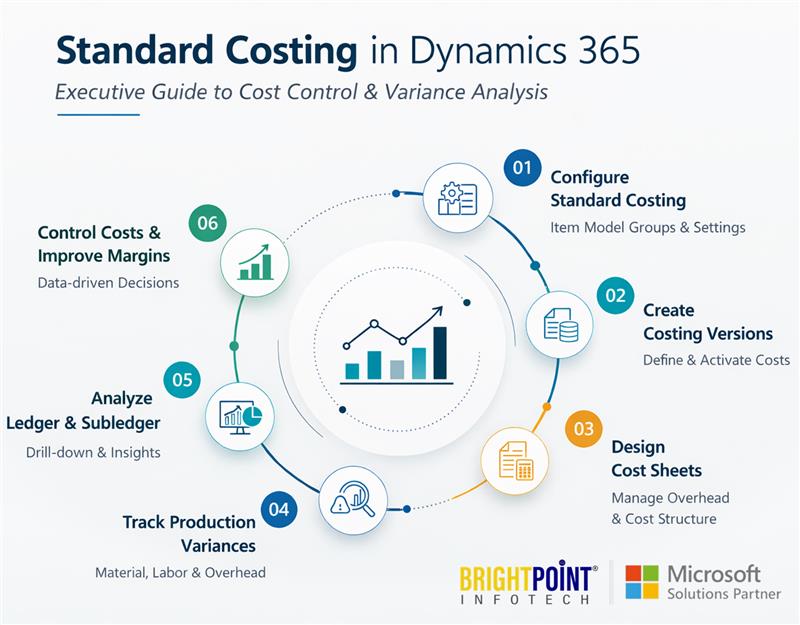
The starting point is the item model group. To use standard costing, Microsoft requires the inventory model to be set to Standard cost. The setup also requires related ledger account assignments for standard cost variances and associated inventory postings. These postings are configured through the inventory posting profile and are foundational to reliable financial output.
The next layer is the costing version. Costing versions hold the cost records and rules that define standard cost, including direct material, direct labor, machine costs, and indirect cost formulas. Microsoft also documents specific restrictions for costing versions used for standard cost, including the requirement that charges be included in item cost and that standard cost calculations for manufactured items rely on cost records in a standard cost version.
Then comes cost group design. Cost groups provide segmentation across cost components, enabling organizations to distinguish, for example, between material, labor, and overhead. This is what allows standard cost to become managerial rather than purely transactional. Without segmentation, an item cost is just a number.
With segmentation, it becomes a decision tool. Microsoft’s prerequisites documentation also notes that cost group configuration influences whether businesses can analyze cost and variances in greater detail.
Why the cost sheet is one of the most important design decisions
The cost sheet is where standard costing becomes visible and intelligible to the business.
In Dynamics 365, the cost sheet is used to structure and display the calculated cost of a manufactured item or production order, including direct and indirect cost components. It also provides the basis for calculating overhead. Microsoft supports indirect cost calculations through surcharge methods, such as a percentage of value, and rate-based methods, such as an hourly rate applied to routing operations. This allows organizations to reflect real cost policy instead of relying on simplistic approximations.
From an executive standpoint, the value of a cost sheet is clarity. It shows whether conversion cost is driven by labor, machine time, setup burden, material handling, or applied overhead. It enables finance and operations to see cost composition through the same lens. And it helps standardize costing logic across sites and product families.
A weak cost sheet often signals weak governance. A strong one usually indicates that the business has defined clear cost policy, aligned stakeholders, and made deliberate choices about overhead allocation.
Configuring standard costing effectively across the organization
Implementing standard costing well requires more than switching on a setting. Microsoft’s prerequisites emphasize several decisions that directly influence the quality of reporting and management insight: item model groups, costing versions, standard cost conversion, cost breakdown policy, and variance tracking policy.
Two settings deserve particular executive attention.
The first is Cost breakdown. When cost breakdown is active, cost group segmentation can be retained for standard cost items, enabling analysis for inventory, work in process, and cost of goods sold at single-level, multi-level, or total views. If cost breakdown is not maintained, the manufactured item’s standard cost is stored as a single amount, which reduces transparency.
The second is Variances to standard. Microsoft allows this to be configured as either Summarized or Per cost group. When set to Per cost group, organizations can identify purchase price variances and the four production variance types by cost group. When set to Summarized, that granularity is lost.
That distinction is critical. If leadership wants standard costing to support performance management and root-cause analysis, summarized variance is rarely enough. Granular variance design gives finance and operations a shared framework for accountability.
The importance of standard cost conversion and controlled updates
For existing environments moving to standard cost, Microsoft provides a structured standard cost conversion process. This process includes preparing item and cost group setup, assigning relevant general ledger accounts, defining standard order quantities where constant costs exist, and activating pending standard costs correctly. Microsoft notes that in manufacturing environments, standard order quantity is especially important because it acts as the accounting lot size for amortizing constant costs such as setup-related route costs or constant BOM quantities.
Microsoft also distinguishes between maintaining active standards and preparing future standards in costing versions. That separation is important from a governance perspective. It allows organizations to evaluate pending cost changes before activation rather than embedding cost changes directly into live operations.
In practice, mature organizations use this capability to align standard cost revisions with period-end controls, annual planning, major supplier changes, new product introductions, or plant-specific process redesign.
How to analyze results using both ledger and subledger data
One of the strongest aspects of Dynamics 365 is that standard costing outcomes are not isolated within supply chain transactions. They connect directly to financial accounting.
Microsoft documents that standard cost variances are posted to designated accounts in the general ledger, including purchase price variance, inventory cost revaluation, cost change variance, and the four production variance categories: lot size variance, price variance, quantity variance, and substitution variance.
This is what allows executives to analyze results through two complementary views:
Subledger view gives operational detail. It helps answer questions such as:
- Did material consumption exceed the expected BOM quantity?
- Was additional labor time reported?
- Was a substitute component issued?
- Did routing or cost category usage differ from the standard calculation?
Ledger view shows the financial consequence. It reveals where those deviations landed in the accounts and how they affect inventory valuation, cost of goods sold, revaluation, and expense recognition. Microsoft’s standard cost variance posting model is built specifically to support this linkage.
This dual perspective is essential for executive oversight. Operations alone cannot explain margin impact completely, and finance alone cannot explain root cause. Standard costing in Dynamics 365 helps bridge those two worlds.
The four production variances leaders should understand
For manufactured items, Dynamics 365 supports four specific production variance types under standard cost:
Production lot size variance reflects differences between the production order basis and the standard cost calculation basis, especially around constant cost amortization.
Production quantity variance arises when material or operational consumption differs from standard expectations.
Production price variance occurs when the cost category or cost category price used in production differs from the values used in standard cost calculation.
Production substitution variance occurs when unexpected materials or operations are consumed, or when the BOM or route used on the order differs from the one used in the standard cost model.
These are not abstract accounting labels. They point directly to operational behavior. Microsoft’s documentation gives concrete examples such as over-issuing material, over-reporting time, selecting a different BOM version, or manually adding non-standard components or operations to a production order.
That is why standard costing is so useful at the executive level. It turns broad margin erosion into specific management questions.
What executives should expect from a mature standard costing model
When standard costing is implemented well in Dynamics 365, leadership should expect more than compliant financial posting. They should expect:
- Better predictability in inventory valuation
- Clearer product cost composition
- Stronger control over overhead logic
- More disciplined standard cost revisions
- Faster identification of unfavorable trends
- Improved alignment between finance, manufacturing, and supply chain
- More actionable variance analysis by item, site, and cost group
In other words, the goal is not merely to calculate cost. The goal is to create a framework that improves confidence in cost, trust in reporting, and speed of corrective action.
Final perspective
Standard costing in Dynamics 365 should be viewed as a strategic control system, not just a finance feature.
When the model is designed correctly, costing versions provide governance, cost sheets provide transparency, cost groups provide insight, and ledger integration provides accountability. The result is a stronger foundation for cost control, margin discipline, and operational decision-making across the enterprise. Microsoft’s documented structure around prerequisites, variance posting, standard cost conversion, and production variance analysis supports exactly that kind of model.
Brightpoint Infotech point of view
At Brightpoint Infotech, we believe standard costing delivers the most value when it is implemented as a business discipline, not just a system setup. The technology matters, but the bigger differentiator is how well costing policy, finance design, production processes, and reporting expectations are aligned.
If your organization is evaluating standard costing in Dynamics 365, redesigning a cost sheet, or trying to improve variance analysis using ledger and subledger data, Brightpoint Infotech can help you build a more controlled, executive-ready cost management framework.
Looking to improve standard costing, cost sheet design, or variance visibility in Dynamics 365? Connect with Brightpoint Infotech to assess your current model and build a more accurate, scalable, and executive-friendly cost management framework.
Explore Brightpoint Infotech Solutions
Explore Our Recent Blogs & Resources
Whether you are a start-up, an SMB, or an enterprise, the Brightpoint Infotech blog is the best place to get inspired and learn more about Microsoft Business Applications.