Modernizing from AX 2012 to Dynamics 365 Finance & Operations: Three Strategic Migration Paths for ERP Leaders
Introduction
As support horizons tighten and cloud ERP adoption accelerates, organizations running Microsoft Dynamics AX 2012 are increasingly evaluating their path to Dynamics 365 Finance & Operations. For CIOs, CFOs, and ERP leaders, this transition is rarely a simple technical upgrade—it is a strategic modernization initiative that impacts finance operations, data governance, and long-term digital agility.
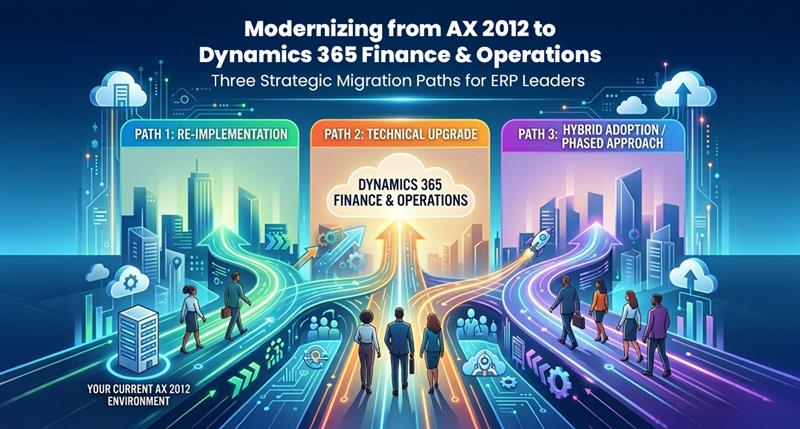
In practice, organizations pursuing this transition typically adopt one of three migration strategies. Each approach reflects different priorities around legacy system complexity, data retention, operational risk, and transformation readiness.
In-Place Upgrade via Lifecycle Services (LCS): Continuity with Full Historical Retention
The in-place upgrade is the most comprehensive migration path and aligns closely with Microsoft’s structured upgrade methodology.
Using Lifecycle Services (LCS), organizations transition their AX 2012 environment—including code and historical data—into Dynamics 365 Finance. The process typically begins with creating an upgrade project in LCS and running diagnostic tools such as the Upgrade Analyzer to evaluate database compatibility and identify code conflicts.
One of the most significant steps in this approach is modernizing customizations. Legacy AX 2012 systems often rely heavily on overlayered modifications, which must be refactored into the extension model used by Dynamics 365. This transformation occurs in development and testing environments before data is upgraded within sandbox environments.
Once validation and user acceptance testing are completed, the final upgraded environment is deployed to production using LCS go-live tools.
This strategy is most appropriate for organizations that:
Require full historical transactional data
Have significant investments in AX customizations
Prefer a structured Microsoft-supported upgrade framework
Want to minimize operational disruption during migration
However, organizations should recognize that this approach may require significant code remediation and testing, particularly in environments with extensive customization.
Clean Implementation with Selective Data Migration: Simplification and ERP Modernization
For many enterprises, the transition from AX 2012 to Dynamics 365 Finance presents a rare opportunity to reset the ERP landscape.
Instead of upgrading the existing system, organizations deploy a clean Dynamics 365 Finance environment and migrate only essential business data—typically master data, configuration elements, and opening balances.
Migration is performed through the Data Management framework, using standardized data entities that support structured import processes. Legacy data is typically extracted, cleansed, and transformed before being loaded into the new system.
The advantage of this strategy lies in simplification. By avoiding the migration of historical transactional data and legacy customizations, organizations can eliminate technical debt and streamline ERP processes.
This approach is particularly effective for organizations that:
Want to standardize business processes
Need to address data quality challenges
Seek faster adoption of modern ERP capabilities
Prefer to avoid legacy customization complexity
While this model sacrifices historical data continuity within the new system, many organizations mitigate this by maintaining archival access to legacy AX environments for reporting purposes.
Automated Migration Using Custom Data Extraction: Speed and Technical Flexibility
A third migration approach combines elements of both strategies while emphasizing automation and technical control.
In this model, organizations develop custom extraction routines within AX 2012 to export structured data directly into flat files aligned with Dynamics 365 Finance data entities. These exports are typically generated using X++ jobs, ensuring the extracted datasets match the schema expected by the Dynamics 365 Data Management framework.
Once exported, the data can be imported directly into Dynamics 365 Finance with minimal mapping or transformation.
This approach enables a repeatable migration process, allowing teams to perform multiple testing cycles during implementation while maintaining consistency across data loads.
Organizations often adopt this strategy when they:
Possess strong internal technical expertise
Want a more automated migration process
Prefer selective data migration without a full system upgrade
Need greater control over migration logic and data transformation
However, the success of this approach depends heavily on the organization’s development capability and data governance practices.
Choosing the Right Migration Strategy
Selecting the right migration path requires a balanced evaluation of both technical and business factors. Key considerations include:
Customization footprint within the AX 2012 environment
Importance of historical transactional data in the new system
Data quality and governance maturity
Operational risk tolerance during ERP transformation
Strategic goals for process modernization
Organizations that approach migration purely as a technical upgrade often miss the broader opportunity to rethink finance and operational processes in a cloud-first ERP environment.
The Strategic Opportunity
For many enterprises, the move from AX 2012 to Dynamics 365 Finance represents more than a platform change—it is an opportunity to modernize financial operations, strengthen data-driven decision-making, and align ERP architecture with cloud-native innovation.
The most successful ERP transformation programs begin not with technology selection, but with a structured upgrade assessment that aligns migration strategy with long-term business objectives.
Organizations that take this strategic view are far more likely to realize the full value of cloud ERP modernization.
Brightpoint Infotech’s Perspective
At Brightpoint Infotech, we believe the move from AX 2012 to Dynamics 365 Finance should not be treated as a technical upgrade alone. It should be approached as a business modernization initiative—one that improves process agility, strengthens reporting visibility, reduces legacy complexity, and positions the organization for long-term scale.
In our view, the right migration strategy depends on more than the current AX footprint. It depends on the organization’s appetite for transformation, the quality of its data, the level of customization in the existing environment, and the business outcomes leadership expects from the next phase of ERP investment.
Some organizations benefit from a full upgrade path to preserve historical continuity. Others are better served by a clean implementation model that simplifies the ERP landscape and removes years of technical debt. In many cases, a selective and automated migration approach provides the right balance between speed, control, and modernization.
What matters most is that the decision is made through a structured assessment, not assumptions.
With deep experience across Microsoft Dynamics 365, ERP modernization, finance transformation, reporting, and industry-specific process optimization, Brightpoint Infotech helps organizations evaluate the most practical and scalable path forward. Our focus is not only on getting to the cloud, but on helping clients move with a strategy that supports business performance, user adoption, and long-term value realization.
Conclusion
There is no single best way to move from AX 2012 to Dynamics 365 Finance. The best approach is the one that aligns technical feasibility with strategic business priorities.
For ERP leaders, this transition is an opportunity to do more than replace a legacy platform. It is a chance to modernize finance operations, improve visibility, simplify architecture, and build a stronger foundation for future growth.
Organizations that approach this shift with the right strategy, governance, and execution model are far more likely to unlock meaningful value from their Dynamics 365 investment.
If your organization is evaluating a move from AX 2012 to Dynamics 365 Finance, Brightpoint Infotech can help you assess the right migration strategy based on your current environment, business priorities, customization footprint, and data readiness.
Contact Brightpoint Infotech to schedule an AX to Dynamics 365 Finance upgrade assessment and define the modernization path that best fits your business.
Explore Brightpoint Infotech Solutions
Explore Our Recent Blogs & Resources Whether you are a start-up, an SMB, or an enterprise, the Brightpoint Infotech blog is the best place to get inspired and learn more about Microsoft Business Applications.