
|
Getting your Trinity Audio player ready...
|
Microsoft Dynamics 365 for Wholesale & Distribution Businesses in Kenya: ERP, Inventory & eTIMS
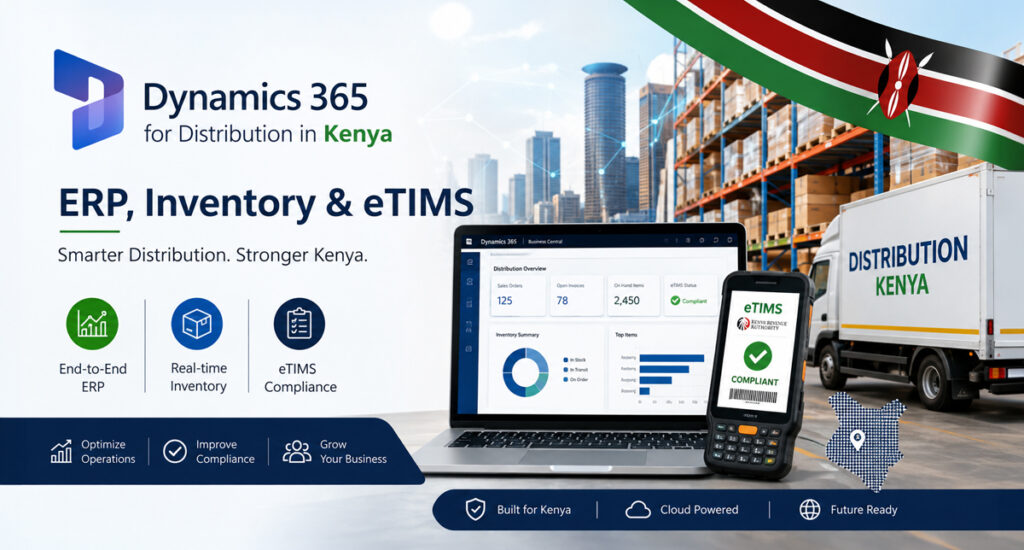
Kenya’s wholesale and distribution businesses are under increasing pressure to manage inventory, orders, warehouses, deliveries, finances, and electronic invoicing more efficiently. For businesses already operating with multiple locations, high transaction volumes, and complex supply chains, disconnected systems can quickly become a barrier to growth.
Microsoft Dynamics 365 provides a unified ERP environment for managing financial and operational processes, while integration with KRA’s electronic Tax Invoice Management System (eTIMS) can help businesses connect their invoicing processes with Kenya’s electronic tax-invoicing framework.
For distributors and wholesalers, the opportunity is not simply to implement another ERP system. It is to create a connected operation where sales, inventory, procurement, warehousing, finance, and invoicing work together.
Why Distribution Businesses in Kenya Need a Connected ERP
Wholesale and distribution operations often involve hundreds or thousands of transactions across customers, suppliers, warehouses, branches, and delivery channels.
A business may have:
- Multiple warehouses and stock locations
- Large volumes of sales invoices
- Different customer pricing structures
- Complex procurement processes
- Stock transfers between locations
- Delivery and logistics operations
- Large supplier networks
- High-volume invoicing
- Multiple branches or distribution centers
- Increasing electronic invoicing requirements
When these processes operate across disconnected systems or spreadsheets, teams may spend significant time reconciling information instead of managing the business.
A modern ERP can bring these processes together.
What Microsoft Dynamics 365 Can Do for Kenyan Distributors
Microsoft Dynamics 365 can provide a centralized platform for managing core distribution operations, including finance, purchasing, sales, inventory, warehouse processes, and supply chain activities.
Inventory Management
Distribution businesses need accurate visibility into what is available, where it is located, and when additional stock is required.
Dynamics 365 can help businesses manage:
- Inventory across multiple locations
- Stock movements and transfers
- Item tracking
- Purchasing and replenishment
- Product availability
- Warehouse inventory
- Batch and serial tracking where applicable
This can help businesses reduce manual inventory processes and make purchasing decisions using more current information.
Warehouse Management
Warehouse efficiency directly affects customer service.
A connected ERP can help distributors manage receiving, picking, packing, stock movement, and order fulfillment from a centralized system.
Instead of relying on separate spreadsheets or disconnected warehouse information, teams can work from a common operational view.
Procurement & Supplier Management
Distributors often work with large supplier networks and recurring purchase requirements.
Dynamics 365 can help connect purchasing with inventory and financial processes so businesses can better manage:
- Purchase orders
- Supplier information
- Purchasing workflows
- Stock replenishment
- Purchase receipts
- Supplier transactions
Sales & Order Management
From customer orders through fulfillment and invoicing, distributors need visibility across the complete sales cycle.
A connected ERP can help businesses manage customer orders, pricing, inventory availability, fulfillment, and financial transactions within a unified environment.
The eTIMS Opportunity for Kenyan Distribution Businesses
This is where the Kenya-specific requirement becomes particularly important.
The Kenya Revenue Authority (KRA) provides eTIMS as its electronic Tax Invoice Management System. KRA states that businesses can use different eTIMS solutions depending on their operating model, including system-to-system integration for businesses that already have invoicing or ERP systems. (KRA)
For businesses with an existing ERP or invoicing system, KRA provides system-to-system integration through an API. Two relevant options are:
- Virtual Sales Control Unit (VSCU) — designed for system-to-system integration and suitable for businesses handling bulk invoicing.
- Online Sales Control Unit (OSCU) — also supports system-to-system integration and is suited to businesses whose invoicing system operates online. (KRA)
This is particularly relevant for wholesale and distribution businesses that generate a large number of invoices.
Why Integrate Microsoft Dynamics 365 With KRA eTIMS?
For a distributor, invoicing should not be an isolated activity.
Ideally, the process should connect the customer’s order, inventory transaction, financial record, and electronic tax invoice.
- Connect ERP and Invoicing Processes
Instead of maintaining separate processes for ERP transactions and electronic tax invoicing, system integration can connect the relevant invoicing workflow with eTIMS.
- Reduce Manual Data Entry
Manual re-entry of invoice information can create unnecessary work and increase the possibility of errors.
Integration can help automate the exchange of relevant information between systems.
- Improve Transaction Visibility
When financial, sales, inventory, and invoicing processes are connected, businesses can gain better visibility into their transactions.
- Support High-Volume Invoicing
This is especially relevant for distributors processing large numbers of customer transactions.
KRA specifically identifies VSCU as suitable for taxpayers undertaking bulk invoicing. (KRA)
- Build a More Connected Distribution Operation
The real value isn’t simply eTIMS integration.
The bigger opportunity is connecting:
Customer Order → Inventory → Warehouse → Delivery → Invoice → Finance → eTIMS
That creates a much more connected operational environment.
Microsoft Dynamics 365 + eTIMS for Wholesale & Distribution
Consider a distributor receiving hundreds of customer orders.
Without an integrated environment, the process might involve:
Order System → Spreadsheet → Warehouse → Separate Invoice System → eTIMS
Every additional system creates another opportunity for delays, duplicate data entry, or reconciliation.
With a connected ERP approach, the objective becomes:
Sales Order → Inventory Availability → Warehouse Fulfillment → Invoice → ERP Finance → eTIMS
The exact architecture and integration approach will depend on the organization’s existing ERP, invoicing processes, transaction volumes, and technical requirements.
But the principle is simple:
Connect the business process instead of managing each process separately.
Which Kenyan Distribution Businesses Can Benefit?
This approach can be particularly relevant for:
Wholesale Distributors
Manage high-volume orders, inventory, purchasing, customer accounts, and invoicing from a connected ERP environment.
FMCG Distribution
Improve inventory visibility, replenishment, warehouse operations, and order fulfillment across distribution networks.
Retail Distribution
Connect central warehouses with retail locations and improve visibility across stock movements and replenishment.
Pharmaceutical Distribution
Manage inventory, purchasing, distribution, and financial processes with greater operational visibility.
Logistics & 3PL Businesses
Connect financial and operational processes while improving visibility across customer orders, warehouse activities, and delivery operations.
Import & Export Businesses
Manage purchasing, inventory, financial processes, documentation, and distribution activities within a unified ERP environment.
What Should Businesses Consider Before eTIMS Integration?
eTIMS integration should not be treated as simply installing another application.
Businesses should first understand their current invoicing and ERP environment.
Consider:
What ERP system are you using?
Businesses already using Microsoft Dynamics 365 may have different integration requirements from businesses migrating from legacy systems.
How many invoices do you process?
Transaction volume can influence the appropriate eTIMS integration approach. KRA identifies VSCU for bulk invoicing and OSCU for online invoicing. (KRA)
How many branches or locations do you operate?
Multi-location distribution businesses should consider how sales, inventory, invoicing, and financial transactions are managed across branches.
What existing systems need to be connected?
A successful integration strategy should consider the complete technology environment—not just the ERP.
Do you need migration as well?
For businesses moving from legacy ERP systems, eTIMS integration can be considered as part of a broader ERP modernization project.
Don’t Treat eTIMS as a Standalone Compliance Project
For distribution businesses, eTIMS shouldn’t necessarily be viewed as a separate technology initiative.
It can be an opportunity to review the entire order-to-cash process.
For example:
Customer Order
↓
Inventory Check
↓
Warehouse Fulfillment
↓
Delivery
↓
Customer Invoice
↓
ERP Financial Transaction
↓
eTIMS Integration
This approach can help businesses think beyond compliance and toward process automation and operational efficiency.
Why Microsoft Dynamics 365 for Distribution?
Microsoft Dynamics 365 can bring finance and operational processes together within a modern ERP environment.
For distribution businesses, this can include capabilities around:
- Financial management
- Inventory management
- Procurement
- Sales management
- Warehouse operations
- Supply chain management
- Reporting and analytics
- Multi-location operations
- Business intelligence
- Integration with other business applications
For growing distribution businesses, the objective is to create a platform that can support current operations while providing room for future growth.
Start Your Business Central Journey With a Clear Scope
For small and mid-sized distribution businesses that are considering Microsoft Dynamics 365 Business Central, getting started doesn’t have to mean a large, complex ERP project.
Brightpoint Infotech offers a Dynamics 365 ERP Starter Package designed to help businesses begin with a defined scope and predictable implementation approach.
The starter package includes:
- Fixed-scope implementation
- Guided Business Central configuration
- Defined deliverables
- ERP setup
- 1 Microsoft Dynamics 365 Business Central license included
- Go-live assistance
Starting at $5,000, the package provides a structured way for eligible businesses to begin their Business Central journey and expand their ERP capabilities as their needs grow.
How Brightpoint Infotech Can Help
Brightpoint Infotech helps businesses plan, implement, optimize, and support Microsoft Dynamics 365 ERP solutions for distribution and supply chain operations.
For Kenyan distribution businesses, the focus can extend beyond ERP implementation to include the processes that matter most to local operations—including inventory, warehouse management, finance, supply chain, and e-invoicing integration requirements.
Our distribution ERP approach can help organizations:
- Assess their current ERP environment
- Plan a Dynamics 365 implementation
- Modernize legacy ERP systems
- Improve inventory and warehouse processes
- Connect financial and operational workflows
- Evaluate eTIMS integration requirements
- Improve reporting and business visibility
- Build a scalable ERP foundation
If you’re evaluating Microsoft Dynamics 365 for a wholesale, distribution, logistics, FMCG, or supply chain business in Kenya, a business-specific assessment is a good place to start.
Explore Microsoft Dynamics 365 ERP Solutions for Distribution Businesses
Conclusion
For Kenyan wholesale and distribution businesses, ERP modernization is no longer only about accounting or inventory management.
The bigger opportunity is to connect the entire operation—from procurement and inventory to warehouse management, sales, finance, delivery, and electronic invoicing.
Microsoft Dynamics 365 can provide the foundation for a connected distribution operation, while integration with KRA eTIMS can help businesses connect their existing ERP or invoicing processes with Kenya’s electronic tax-invoicing framework. KRA officially provides system-to-system integration options through VSCU and OSCU for businesses with existing invoicing/ERP systems. (KRA)
For distributors handling high transaction volumes, multiple warehouses, and complex supply chains, the goal shouldn’t simply be “implement ERP.”
It should be:
Build a connected, visible, and scalable distribution operation.
And that’s where Dynamics 365 + distribution automation + eTIMS integration can become a powerful combination for businesses operating in Kenya.