
Microsoft Dynamics 365 Business Central for Manufacturing: The Complete Guide for Modern Manufacturers in 2026
Introduction
Manufacturing businesses today face increasing pressure to improve efficiency, reduce operational costs, manage supply chain disruptions, and meet customer demands faster than ever before. Many manufacturers still rely on disconnected systems, spreadsheets, and outdated software that limit visibility across production, inventory, procurement, and finance.
As the manufacturing industry continues its digital transformation journey, Enterprise Resource Planning (ERP) systems have become essential for sustainable growth and operational excellence.
Among the leading ERP solutions available today, Microsoft Dynamics 365 Business Central stands out as a powerful, scalable, and cost-effective platform designed to help manufacturers streamline operations, improve productivity, and gain real-time visibility across their business.
In this guide, we’ll explore how Dynamics 365 Business Central helps manufacturers overcome common challenges, optimize production processes, and prepare for future growth.
What Is Microsoft Dynamics 365 Business Central?
Microsoft Dynamics 365 Business Central is a comprehensive cloud-based ERP solution designed for small and medium-sized businesses. It integrates finance, sales, purchasing, inventory, manufacturing, warehouse management, supply chain operations, project management, and customer service into a single platform.
For manufacturers, Business Central provides end-to-end visibility across the entire production lifecycle—from raw material procurement to finished goods delivery.
Unlike traditional ERP systems that require significant infrastructure investments, Business Central offers flexibility, scalability, and accessibility through Microsoft’s secure cloud platform.
Why Manufacturers Need Modern ERP Software
Manufacturing companies often encounter operational challenges that directly impact profitability and customer satisfaction.
Common challenges include:
Limited Visibility
Many businesses operate with separate systems for finance, inventory, production, and sales. This creates information silos that make decision-making difficult.
Inventory Inaccuracies
Without real-time inventory tracking, manufacturers face stock shortages, excess inventory, and production delays.
Production Inefficiencies
Manual scheduling and disconnected processes can lead to bottlenecks, machine downtime, and missed delivery deadlines.
Supply Chain Disruptions
Global supply chain volatility makes it essential to monitor supplier performance, inventory levels, and procurement activities in real time.
Inaccurate Forecasting
Without reliable data, manufacturers struggle to forecast demand accurately, leading to overproduction or inventory shortages.
A modern ERP system addresses these challenges by providing a centralized source of truth for the entire organization.
Key Manufacturing Features in Dynamics 365 Business Central
1. Production Management
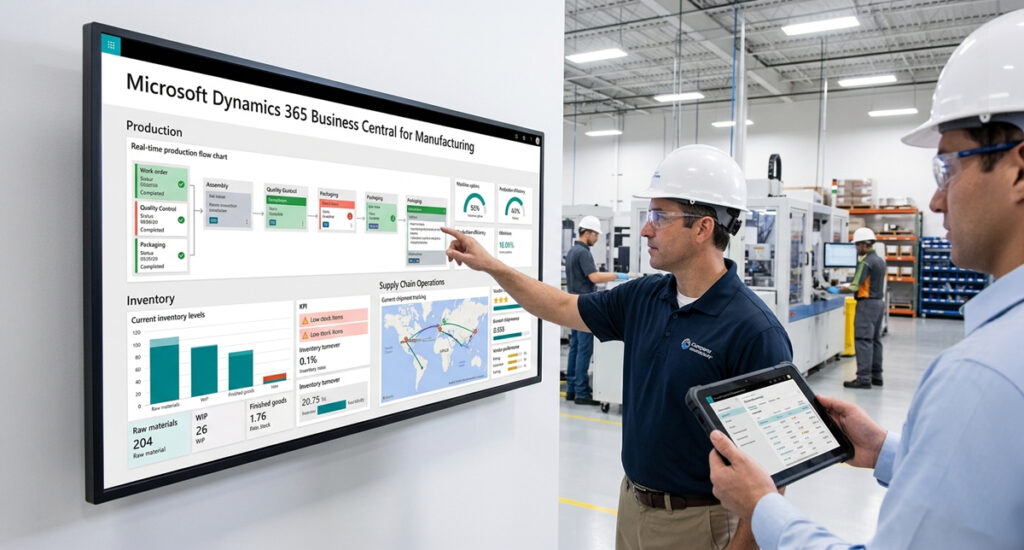
Business Central helps manufacturers manage production orders efficiently while maintaining complete visibility into the manufacturing process.
Capabilities include:
- Production order creation
- Routing management
- Capacity planning
- Production scheduling
- Resource allocation
- Shop floor visibility
Manufacturers can monitor production progress in real time and quickly respond to unexpected changes.
2. Bill of Materials (BOM) Management
Accurate BOM management is critical for manufacturing success.
Business Central enables organizations to:
- Create multi-level BOMs
- Manage component structures
- Track material usage
- Control product versions
- Maintain manufacturing consistency
This ensures production teams always work with accurate product specifications.
3. Material Requirements Planning (MRP)
Material shortages can disrupt production schedules and impact customer satisfaction.
Business Central’s MRP functionality helps businesses:
- Forecast material demand
- Generate replenishment suggestions
- Optimize purchasing decisions
- Reduce inventory carrying costs
- Prevent stockouts
Manufacturers gain confidence that required materials will be available when needed.
4. Inventory Management
Inventory represents a significant investment for manufacturing businesses.
Business Central provides:
- Real-time inventory tracking
- Lot and serial number management
- Warehouse visibility
- Inventory valuation
- Automated replenishment
- Multi-location inventory control
Improved inventory accuracy reduces waste and improves cash flow.
5. Warehouse Management
Efficient warehouse operations directly impact production performance.
Business Central supports:
- Put-away management
- Picking and packing
- Bin management
- Warehouse movements
- Cycle counting
- Inventory optimization
Warehouse teams can operate more efficiently while maintaining inventory accuracy.
6. Supply Chain Management
Managing suppliers effectively is critical for manufacturing success.
Business Central helps organizations:
- Track vendor performance
- Manage purchase orders
- Monitor lead times
- Improve procurement planning
- Reduce supply chain risks
Better supplier management contributes to more predictable production outcomes.
Benefits of Dynamics 365 Business Central for Manufacturing Companies
Improved Operational Efficiency
By automating manual processes and integrating departments, manufacturers can eliminate redundant tasks and improve productivity.
Employees spend less time entering data and more time focusing on value-added activities.
Real-Time Business Visibility
Decision-makers gain access to accurate, real-time information across the organization.
Dashboards and reporting tools provide insights into:
- Production performance
- Inventory levels
- Financial health
- Sales trends
- Supply chain activities
This visibility supports faster and more informed decision-making.
Better Production Planning
Production planners can use accurate data to create realistic schedules and allocate resources effectively.
This leads to:
- Reduced downtime
- Improved resource utilization
- Faster production cycles
- On-time delivery performance
Reduced Inventory Costs
Many manufacturers carry excess inventory as a buffer against uncertainty.
Business Central helps optimize inventory levels through better forecasting and planning.
Benefits include:
- Lower carrying costs
- Reduced obsolete inventory
- Improved cash flow
- Better warehouse utilization
Enhanced Customer Satisfaction
Customers expect accurate delivery dates and consistent product quality.
Business Central enables manufacturers to:
- Improve order accuracy
- Reduce delivery delays
- Respond faster to customer inquiries
- Maintain quality standards
This contributes to stronger customer relationships and repeat business.
How Dynamics 365 Business Central Supports Different Manufacturing Models
Discrete Manufacturing
Businesses producing individual products such as machinery, electronics, or industrial equipment can benefit from:
- BOM management
- Production orders
- Routing management
- Inventory tracking
Process Manufacturing
Manufacturers producing chemicals, food products, or pharmaceuticals can use Business Central to manage:
- Batch production
- Formula management
- Quality control processes
- Inventory traceability
Make-to-Order Manufacturing
Companies that manufacture products based on customer specifications can improve visibility and control throughout the order lifecycle.
Business Central helps ensure projects remain profitable while meeting customer expectations.
Manufacturing Reporting and Analytics
Data-driven decision-making has become a competitive necessity.
Business Central provides comprehensive reporting capabilities that help manufacturers analyze performance and identify improvement opportunities.
Key metrics include:
- Production efficiency
- Inventory turnover
- Supplier performance
- Order fulfillment rates
- Financial performance
- Capacity utilization
Integration with Microsoft Power BI further enhances reporting and visualization capabilities.
Organizations can create customized dashboards that provide executives and managers with actionable insights.
Cloud ERP Advantages for Manufacturers
Many manufacturers are transitioning from on-premises ERP systems to cloud-based solutions.
Business Central offers several cloud advantages:
Accessibility
Users can securely access the system from any location.
Scalability
The platform grows with the business without requiring major infrastructure investments.
Security
Microsoft’s cloud infrastructure provides enterprise-grade security and compliance.
Automatic Updates
Businesses always have access to the latest features and innovations.
Reduced IT Costs
Cloud deployment eliminates many hardware and maintenance expenses associated with traditional ERP systems
Common Manufacturing ERP Implementation Challenges
Although ERP projects deliver significant benefits, manufacturers should be aware of common implementation challenges.
Data Migration
Migrating legacy data requires careful planning and validation.
Change Management
Employees must adapt to new processes and technologies.
User Training
Comprehensive training ensures users can effectively utilize the system.
Process Alignment
Organizations should review existing processes and eliminate inefficiencies before implementation.
Working with an experienced implementation partner helps reduce risks and improve project outcomes.
Why Choose Dynamics 365 Business Central Over Legacy Systems?
Legacy systems often struggle to meet modern manufacturing requirements.
Compared to traditional ERP solutions, Business Central offers:
- Modern cloud architecture
- Seamless Microsoft integration
- Lower total cost of ownership
- Real-time analytics
- Improved user experience
- Greater flexibility
- AI-powered capabilities
Manufacturers can modernize operations without the complexity and cost associated with large enterprise ERP platforms.
Future Trends: AI and Manufacturing ERP
Artificial intelligence is transforming manufacturing operations worldwide.
Business Central continues to evolve with AI-powered capabilities that help organizations:
- Improve forecasting accuracy
- Automate repetitive tasks
- Generate business insights
- Detect anomalies
- Enhance decision-making
As manufacturers embrace Industry 4.0 initiatives, ERP systems will play an increasingly important role in connecting data, people, and processes.
How Brightpoint Infotech Helps Manufacturers Succeed
Implementing ERP software is more than a technology project—it is a business transformation initiative.
At Brightpoint Infotech, we help manufacturing companies successfully implement Microsoft Dynamics 365 Business Central through:
- ERP consulting and assessment
- Business process optimization
- System implementation
- Data migration
- User training
- Customization and integrations
- Ongoing support and managed services
Our team works closely with manufacturers to ensure solutions align with operational goals and deliver measurable business value.
Conclusion
Manufacturing businesses can no longer rely on disconnected systems and manual processes to remain competitive. Modern manufacturers need real-time visibility, efficient production planning, optimized inventory management, and data-driven decision-making capabilities.
Microsoft Dynamics 365 Business Central provides a comprehensive ERP platform that helps manufacturers streamline operations, improve productivity, reduce costs, and support long-term growth.
Whether you’re looking to modernize legacy systems, improve production efficiency, or prepare your business for future expansion, Business Central offers the flexibility and functionality required to succeed in today’s rapidly evolving manufacturing landscape.
If your organization is considering a manufacturing ERP solution, partnering with an experienced implementation provider can help ensure a successful and cost-effective transformation journey.
Explore Brightpoint Infotech Solutions
Explore Our Recent Blogs & Resources
Whether you are a start-up, an SMB, or an enterprise, the Brightpoint Infotech blog is the best place to get inspired and learn more about Microsoft Business Applications.