

|
Getting your Trinity Audio player ready...
|
How Dynamics 365 Helps Process Manufacturers Improve Batch Consistency, Traceability, and Production Control
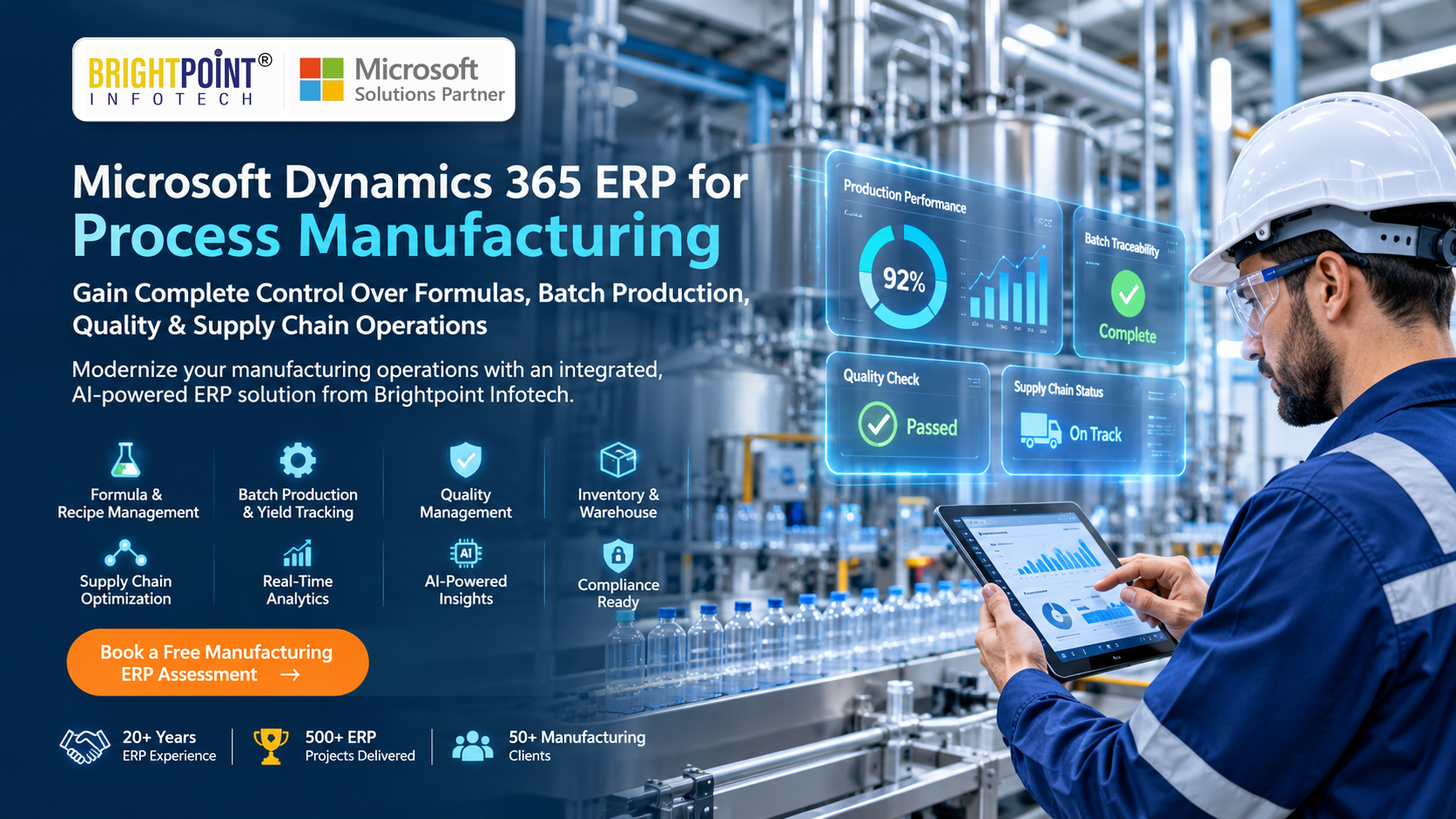
Process manufacturers face a different set of operational challenges than discrete manufacturers. Production depends on formulas, ingredients, raw material quality, batch quantities, processing conditions, and the ability to maintain consistent product quality across every production run.
Whether a business manufactures food and beverages, chemicals, pharmaceuticals, cosmetics, plastics, or agricultural products, even a small variation in raw materials or production processes can affect the final product.
When formulas are maintained in spreadsheets, batch records are managed manually, and quality information is spread across different systems, manufacturers can struggle to maintain production consistency, control costs, and respond quickly to quality issues.
This is where a well-implemented process manufacturing ERP system can make a difference. Microsoft Dynamics 365 Supply Chain Management provides process manufacturing capabilities that help businesses manage formulas, batch orders, production planning, inventory, and manufacturing operations within an integrated business system.
In this blog, we explore the common challenges process manufacturers face, the ERP capabilities that help address them, and how Microsoft Dynamics 365 can support better production control and operational visibility.
Why Process Manufacturing Requires Specialized ERP Capabilities
Unlike discrete manufacturing, where products are commonly assembled from individual components, process manufacturing transforms ingredients or raw materials through defined production processes. For example:
- A food manufacturer combines ingredients according to a recipe to produce a specific batch.
- A chemical manufacturer follows a formula with controlled material quantities and processing stages.
- A pharmaceutical manufacturer manages ingredients, production batches, and quality requirements.
- A cosmetics manufacturer needs consistency in formulations, product characteristics, and finished-product quality.
These operations require more than basic inventory and production order management. Manufacturers need to understand what went into each batch, which formula version was used, how much material was consumed, what quantity was produced, and whether the finished product passed the required quality checks.
7 Common Process Manufacturing Challenges and How ERP Helps Address Them
Managing Formula and Recipe Changes
Formulas are central to process manufacturing. They define the ingredients, quantities, and expected outputs required to produce a finished product. However, formulas can change because of supplier variations, material availability, product improvements, cost adjustments, or customer requirements. When teams rely on spreadsheets or manually maintained records, it becomes difficult to ensure that production uses the correct formula.
An ERP system with formula management capabilities helps manufacturers maintain ingredient details, formula versions, approval processes, and effective dates.
Microsoft Dynamics 365 Supply Chain Management supports formula versions and allows manufacturers to define formula lines, manage formula changes, and account for co-products and by-products where applicable. This helps production teams work with more controlled manufacturing information and reduces dependence on disconnected records.
Maintaining Batch Consistency and Production Control
Producing the same product repeatedly does not always mean every batch will have identical results. Differences in raw material quality, ingredient quantities, production conditions, or process execution can affect the finished product. For manufacturers, these variations can lead to rework, material waste, customer complaints, and additional production costs.
Batch production management helps manufacturers plan, estimate, schedule, release, and monitor production orders. With Dynamics 365 Supply Chain Management, manufacturers can work with batch orders and connect production activities with formulas, material requirements, inventory, and production costing.
This provides a more structured approach to managing production from order creation through completion.
Improving Raw Material and Finished Product Traceability
Traceability becomes especially important when a quality issue affects a particular batch. Manufacturers may need to identify:
- Which raw material lots were used?
- Which suppliers provided those materials?
- Which production batches consumed them?
- Which finished products were created?
- Where were those products stored or shipped?
If this information is spread across spreadsheets, warehouse records, and separate production systems, investigating a quality issue can take significant time.
Batch and inventory tracking capabilities help businesses maintain information about tracked materials and products across relevant inventory transactions. With appropriate tracking dimensions, warehouse processes, and transaction recording, manufacturers can improve visibility into material movement and production history.
This supports more efficient investigations and helps teams understand the potential impact of a quality issue.
Managing Product Quality Throughout Production
Quality control should not be limited to inspecting the finished product. Manufacturers may need to monitor incoming raw materials, production-stage checks, batch characteristics, and final product inspections. For example, a food manufacturer may need to check ingredient quality, production parameters, and finished-product characteristics, while a chemical manufacturer may need to verify specific product properties before releasing a batch.
Quality management processes can help manufacturers define inspections, record test results, manage nonconformances, and control product release according to configured business processes. Connecting quality information with production and inventory records can make it easier for teams to investigate issues and maintain better operational visibility.
Struggling with batch consistency or traceability?
Get a practical view of how Dynamics 365 fits your formulas, batches, and quality processes.
Controlling Inventory, Shelf Life, and Material Availability
Process manufacturers often work with materials that have specific storage conditions, expiration dates, or limited usable shelf life. Poor inventory visibility can lead to expired materials, unnecessary purchasing, production delays, and avoidable waste.
An integrated ERP system connects inventory information with procurement, production planning, and warehouse operations. Dynamics 365 supports batch tracking and shelf-life-related planning capabilities. For applicable products, manufacturers can configure expiration information and use first-expire, first-out (FEFO) inventory strategies.
This can help businesses make more informed material allocation and replenishment decisions.
Understanding Production Costs and Material Consumption
Production costs are influenced by more than the purchase price of raw materials. Manufacturers also need to consider actual material consumption, production resources, labor, overhead, waste, and variations between planned and actual output. When cost information is not connected to production activities, identifying the reasons behind margin changes becomes difficult.
Manufacturing ERP capabilities connect production transactions with inventory and financial information. Dynamics 365 Supply Chain Management supports production costing and different inventory valuation methods, depending on the configured costing model.
This helps manufacturers improve visibility into production costs and investigate differences between expected and actual consumption.
Connecting Production Information Across Departments
Production teams, purchasing departments, warehouse staff, quality teams, finance, and management all depend on accurate operational information. When each department uses separate systems, information gaps can delay decisions.
An integrated ERP environment connects business processes across departments. Microsoft Dynamics 365 can bring together supply chain, production, inventory, procurement, and financial processes (including Dynamics 365 Finance & Operations), helping teams work with more consistent business information.
The result is better coordination between operational and management teams.
How Microsoft Dynamics 365 Supports the Process Manufacturing Workflow
A process manufacturing ERP should support the complete production lifecycle rather than managing individual activities in isolation. Here is how an integrated workflow can operate:
Step 1: Define the Formula
Manufacturers establish the ingredients, material quantities, formula versions, and expected production outputs.
Step 2: Plan Material Requirements
Production planning considers demand, available inventory, material requirements, and replenishment needs.
Step 3: Create and Estimate the Batch Order
The manufacturer creates a batch order and estimates the materials and resources required for production.
Step 4: Schedule and Execute Production
Production activities are scheduled and released. Teams record material consumption and relevant production transactions.
Step 5: Record Quality Information
Configured quality processes capture inspection results and help teams manage products that require further review.
Step 6: Complete Production and Update Inventory
Finished products and applicable co-products or by-products are recorded in the system, with inventory and costing information updated through the relevant transactions.
Step 7: Review Production Performance
Management reviews production costs, material consumption, inventory, quality information, and operational performance using available reports and analytics.
This connected approach helps reduce information gaps between planning, production, inventory, and financial operations.
Manufacturing KPIs That Process Manufacturers Should Monitor
An ERP system is valuable not only because it records transactions, but also because it helps manufacturers understand how their operations are performing. Some important process manufacturing KPIs include:
| KPI | What It Helps Measure |
|---|---|
| Batch yield | Actual output compared with expected output |
| Material consumption variance | Difference between planned and actual material usage |
| Production cycle time | Time required to complete a production process |
| Batch rejection rate | Percentage of batches rejected during quality checks |
| Scrap and rework | Material loss and additional work required |
| Inventory turnover | How efficiently inventory is being used |
| On-time production completion | Whether production orders are completed as scheduled |
| Production cost variance | Difference between expected and actual production costs |
These measurements help production and management teams identify operational issues and prioritize improvements. The availability and calculation of each KPI depend on the underlying data, reporting configuration, and connected systems.
Where AI and Advanced Analytics Can Improve Manufacturing Operations
Manufacturing operations generate large amounts of information from production, inventory, equipment, quality checks, and supply chain activities. When this information is connected and analyzed effectively, manufacturers can gain better visibility into their operations. AI and analytics can support areas such as:
- Identifying unusual patterns in production data.
- Improving visibility into material consumption and production performance.
- Analyzing quality trends across production batches.
- Supporting demand and inventory planning.
- Helping management make more informed operational decisions.
Microsoft's broader business technology ecosystem includes Dynamics 365, Power BI, Microsoft Fabric, and Copilot capabilities. These technologies can support reporting, data analysis, and productivity when the required services, integrations, and configurations are in place.
AI-Powered Visual Inspection with DefectGuard
For manufacturers working with visible product defects, traditional manual inspection can become challenging, particularly when production volumes are high and inspection requirements are repetitive. Brightpoint's DefectGuard is an AI-powered visual inspection solution designed to identify and classify visible defects using computer vision.
For applicable manufacturing environments, visual inspection can help teams detect product issues, review defect patterns, and improve quality monitoring. For example, in fabric manufacturing, visual inspection can help identify issues such as holes, stains, broken yarns, and other surface defects.
What Should Manufacturers Look for When Choosing a Process Manufacturing ERP?
Selecting an ERP system is a long-term business decision. Manufacturers should evaluate whether the solution supports their actual production requirements rather than choosing a system based only on a feature list. Consider these questions before making a decision:
- Formula management: Can the system manage formula versions, ingredient quantities, and relevant formula approvals?
- Batch production: Can production teams create, estimate, schedule, and track batch orders?
- Traceability: Can the business track raw materials and finished products using appropriate batch and inventory records?
- Quality management: Can quality checks and inspection results be connected to relevant business processes?
- Shelf-life management: Can the system support expiration dates and applicable inventory strategies?
- Production costing: Can the business understand material consumption and production costs?
- Supply chain integration: Can purchasing, inventory, warehousing, production, and finance work together?
- Reporting: Can management access meaningful production and business performance information?
- Scalability: Can the solution support additional facilities, business units, products, and operational complexity?
- Implementation experience: Does the implementation partner understand the company's manufacturing processes and industry requirements?
Smaller or less complex manufacturers may also want to look at Dynamics 365 Business Central, while larger or multi-site operations typically evaluate Supply Chain Management together with Finance & Operations.
The right solution should be evaluated against the manufacturer's product types, production methods, regulatory obligations, integrations, and future business plans.
Why Work with a Microsoft Dynamics 365 Implementation Partner?
Implementing manufacturing ERP is not simply a software installation. It requires an understanding of production workflows, inventory processes, business requirements, data, integrations, and reporting. An experienced implementation partner can help manufacturers:
- Review existing manufacturing and supply chain processes.
- Identify operational gaps and ERP requirements.
- Determine the appropriate Dynamics 365 solution and implementation scope.
- Configure relevant production, inventory, and financial processes.
- Plan data migration and integrations.
- Support testing, user training, and deployment.
- Improve the system as business requirements evolve.
Brightpoint Infotech helps businesses implement Microsoft Dynamics 365 solutions to support manufacturing, supply chain, finance, and business operations. With manufacturing ERP experience and Microsoft technology expertise, Brightpoint works with businesses to evaluate their requirements and plan an implementation aligned with their operational needs.
Not sure which Dynamics 365 solution fits?
A short assessment can clarify the right products, configuration, and implementation scope.
Frequently Asked Questions
1. What is process manufacturing ERP?
Process manufacturing ERP is business software designed to support manufacturers that produce goods using formulas, recipes, ingredients, and batch or semi-continuous production processes. It connects production planning, inventory, procurement, quality, costing, and other business operations.
2. How is process manufacturing ERP different from discrete manufacturing ERP?
Process manufacturing generally uses formulas and recipes to define ingredients and production outputs. Discrete manufacturing commonly uses bills of materials to define individual components assembled into finished products. Some manufacturing environments use a combination of both approaches.
3. Does Microsoft Dynamics 365 support process manufacturing?
Yes. Microsoft Dynamics 365 Supply Chain Management includes process manufacturing capabilities such as formula management, formula versions, batch orders, and support for co-products and by-products. The exact solution scope depends on configuration and business requirements.
4. Can Dynamics 365 manage manufacturing formulas and recipes?
Dynamics 365 Supply Chain Management supports formulas and formula versions, including ingredient lines and relevant formula characteristics. Manufacturers can configure formula versions for applicable products and production requirements.
5. Can Dynamics 365 support batch production?
Yes. Dynamics 365 Supply Chain Management supports batch orders for applicable process manufacturing scenarios. These orders can be created, estimated, scheduled, released, and processed through the production lifecycle.
6. How does ERP help with batch traceability?
ERP helps maintain inventory and production transaction records associated with tracked materials and products. With appropriate batch tracking, warehouse processes, and transaction recording, manufacturers can improve visibility into material movement and production history.
7. Can process manufacturing ERP help reduce material waste?
It can help improve visibility into material requirements, actual consumption, inventory, production output, and costing. Manufacturers can use this information to identify material variances and investigate opportunities to reduce waste. Actual results depend on process discipline and system configuration.
8. Can Dynamics 365 support shelf-life management?
Dynamics 365 Supply Chain Management supports shelf-life-related product and planning capabilities, including applicable expiration-date settings and FEFO inventory strategies. These capabilities need to be configured according to product and warehouse requirements.
9. Can AI improve manufacturing quality inspection?
AI-powered visual inspection can help identify and classify visible product defects. Solutions such as Brightpoint's DefectGuard can complement ERP operations by supporting computer-vision-based inspection in applicable manufacturing environments.
10. How do I choose the right Dynamics 365 solution for my manufacturing business?
The right solution depends on production complexity, formula and batch requirements, financial processes, inventory needs, reporting, integrations, and business growth plans. A manufacturing assessment can help determine the appropriate Dynamics 365 products, configuration, and implementation scope.
Continue Learning
Want to go deeper? These resources explain the Microsoft Dynamics 365 solutions mentioned in this blog.
Improve Process Control with the Right Manufacturing ERP Solution
Managing formulas, production batches, material traceability, quality, and production costs requires connected business processes and reliable operational information.
Brightpoint Infotech helps businesses assess their manufacturing requirements and plan Microsoft Dynamics 365 ERP implementations aligned with their operational goals.
Looking to improve your manufacturing operations?
Talk to Brightpoint Infotech about your process manufacturing requirements.


