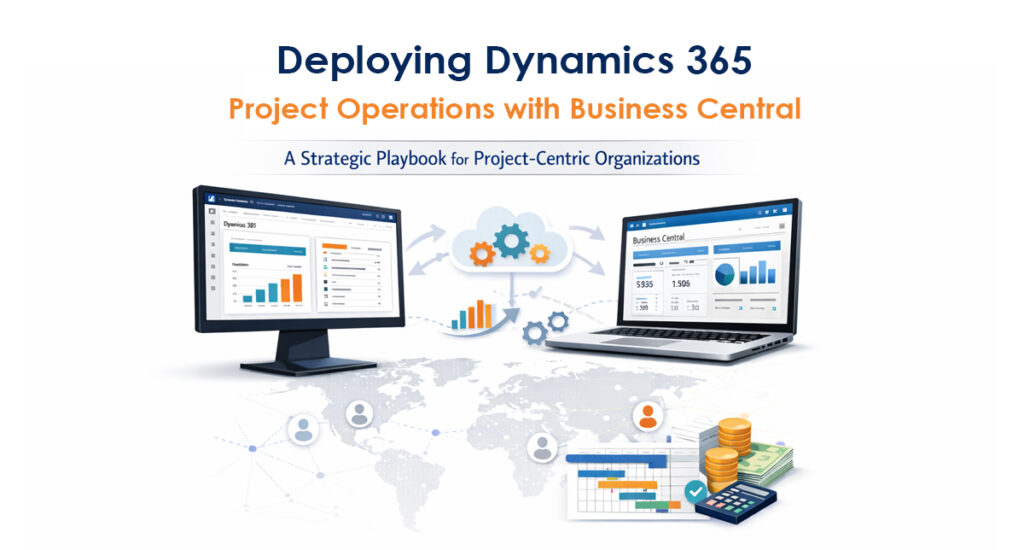
Deploying Dynamics 365 Project Operations with Business Central: A Strategic Playbook for Project-Centric Organizations
Introduction
As project-driven organizations scale, operational complexity increases exponentially. Fragmented systems, manual handoffs, and limited financial visibility often become structural barriers to growth. One of the most effective ways to address these challenges is through a strategic integration of Dynamics 365 Project Operations with Dynamics 365 Business Central.
Based on real-world deployment patterns and best practices discussed at major Microsoft business application forums, this blog outlines a pragmatic, architecture-first approach to deploying Project Operations with Business Central—focused on business outcomes, not just technology alignment.
Why Integrate Project Operations with Business Central?
From a strategic standpoint, organizations pursue this integration for one core reason: to unify project execution with financial governance without slowing either function down.
In mature project-centric enterprises, project managers and finance teams operate with fundamentally different objectives, timelines, and metrics. Project Operations and Business Central are purpose-built to support these distinct needs—yet deliver the most value when tightly integrated.
Strategic Triggers for Integration
Integration makes the most sense when organizations:
Run forecast-driven, milestone-based, or time-and-materials projects
Require real-time visibility into project cost, revenue, and WIP
Struggle with manual revenue recognition and billing workflows
Experience friction between project delivery and accounting teams
Industry Fit: Where the Value Is Highest
This integrated model is particularly effective for service-oriented and project-heavy industries, including:
Construction & Engineering
Manufacturing (Project-Based or Make-to-Order)
Professional & IT Consulting
System Integrators and Managed Service Providers
These industries share a common requirement: tight alignment between project progress and financial outcomes.
Common Challenges Without Integration
Organizations operating Project Operations and ERP systems in silos typically face:
Manual data movement between project and finance systems (budgets, job costs, change orders, billing)
Excessive status meetings to reconcile project and accounting data
Limited financial visibility for project managers
Limited operational visibility for finance teams
Spreadsheet-driven or manual revenue recognition processes
Over time, these inefficiencies increase risk, delay decision-making, and erode margins.
Business Impact: What an Integrated Model Delivers
Streamlined End-to-End Project Lifecycle
A well-designed integration enables a seamless flow from:
Lead → Opportunity → Quote → Project Creation
Time & milestone tracking → Billing → AR → Cash collection
This eliminates duplicate data entry and ensures that project execution and financial reporting stay synchronized.
Reduced Duplication of Effort
Integration minimizes repeated work across:
Project and budget creation
Labor time entry
Billing communication
AR and collections coordination
The result: lower operational overhead and faster close cycles.
Enforced Segregation of Duties
A clear system boundary supports governance and audit readiness:
Project Operations
Planning, scheduling, forecasting
Budget ownership
Resource coordination
Change and risk management
Business Central
Cost tracking
Revenue recognition
Billing and invoicing
Compliance, reporting, and cash flow management
This separation is not a limitation—it is a control mechanism.
Architecture Matters: Choosing the Right Integration Model
From an enterprise architecture perspective, organizations typically evaluate two integration patterns:
Fully Integrated (GL-Based) Model
Best suited for organizations that require:
Budget vs actual cost visibility in both systems
WIP management
Financial control centralized in Business Central
Project Operations as the operational front end
This model delivers the highest level of financial accuracy and governance.
Actuals-Based Integration
More suitable when:
Project Operations leads billing initiation
Business Central acts primarily as the financial system of record
WIP and advanced budgeting are less critical
While simpler, this approach trades off some financial insight for operational flexibility.
Advanced Scenarios: Custom Functionality That Drives Differentiation
Early Project Creation
Creating projects at the opportunity stage enables:
Early SOW development
More accurate quoting and budgeting
Stronger alignment between sales and delivery
Change Order Management (Parent–Child Projects)
Since Project Operations does not natively support change orders:
Child projects can be created for change requests
Approved changes can be rolled into the parent project
Budgets and tasks remain auditable and traceable
This approach preserves both financial integrity and delivery agility.
Integration “Must-Haves” for Long-Term Success
Before deploying, organizations must clearly define:
System of record for rates, resources, tasks, customers
Core integration components:
Project headers
Tasks
Time entry
Billing
The right integration toolset aligned with scale and complexity
Technology alone does not solve integration challenges—governance and design decisions do.
Key Takeaways for CIOs, CFOs, and Delivery Leaders
Integration delivers measurable business value, not just technical efficiency
Architecture choices should reflect core business processes
Data should live where it delivers the highest decision value
A well-executed integration saves time, cost, and operational friction
Brightpoint Infotech’s Perspective
At Brightpoint Infotech, we approach Dynamics 365 integrations with a business-first, architecture-driven mindset. Our experience across manufacturing, construction, consulting, and services organizations shows that the most successful deployments are not the most complex—but the most intentional.
If your organization is evaluating Dynamics 365 Project Operations with Business Central, the critical question is not can they be integrated—but how they should be integrated to support growth, governance, and profitability.
Explore Brightpoint Infotech Solutions
Explore Our Recent Blogs & Resources Whether you are a start-up, an SMB, or an enterprise, the Brightpoint Infotech blog is the best place to get inspired and learn more about Microsoft Business Applications.