

|
Getting your Trinity Audio player ready...
|
Why Bank Statement Automation Is Becoming a Finance Transformation Priority
A practical framework for connecting bank data to Microsoft Dynamics 365 Finance, strengthening reconciliation controls and reducing manual finance work.
Bank reconciliation is often described as a routine back-office activity. In practice, it sits at the intersection of cash visibility, financial control, audit readiness and the speed of period close. When statement data arrives late, requires manual handling or cannot be matched consistently, the resulting friction extends well beyond the reconciliation team.
The issue is rarely that finance lacks a reconciliation function. The more common constraint is the operating gap between the bank and the enterprise resource planning system. Teams still download files or get them in their email, rename them to save a justifiable copy, validate formats, upload data and investigate preventable import failures before reconciliation can even begin.
For organizations using Microsoft Dynamics 365 Finance, closing this gap requires a clear distinction between two capability layers. Dynamics 365 provides the financial processes used to import statements, apply matching rules, manage vouchers, investigate exceptions and complete reconciliation. A bank connectivity layer can automate the secure retrieval and controlled delivery of statement files into that process.
This distinction matters. It keeps the transformation case grounded in operational reality and helps executives invest in the part of the process that is still manual, inconsistent or difficult to govern.
Manual Handling Is a Control Design Problem
Manual statement processing is usually evaluated in terms of effort. That understates the risk. Every handoff between a bank portal, a local folder, an email inbox and the ERP creates another point where files can be delayed, duplicated, altered, misclassified or omitted unintentionally.
The concern is not that finance professionals cannot manage these steps. It is that the process depends on individual discipline at precisely the point where organizations need consistency and traceability. As transaction volumes, bank accounts and legal entities increase, that dependency becomes harder to sustain.
A more mature operating model does not attempt to remove finance oversight. It removes repetitive handling and concentrates human attention on exceptions, unusual transactions and decisions requiring judgment.
The Missing Layer Between the Bank and Dynamics 365
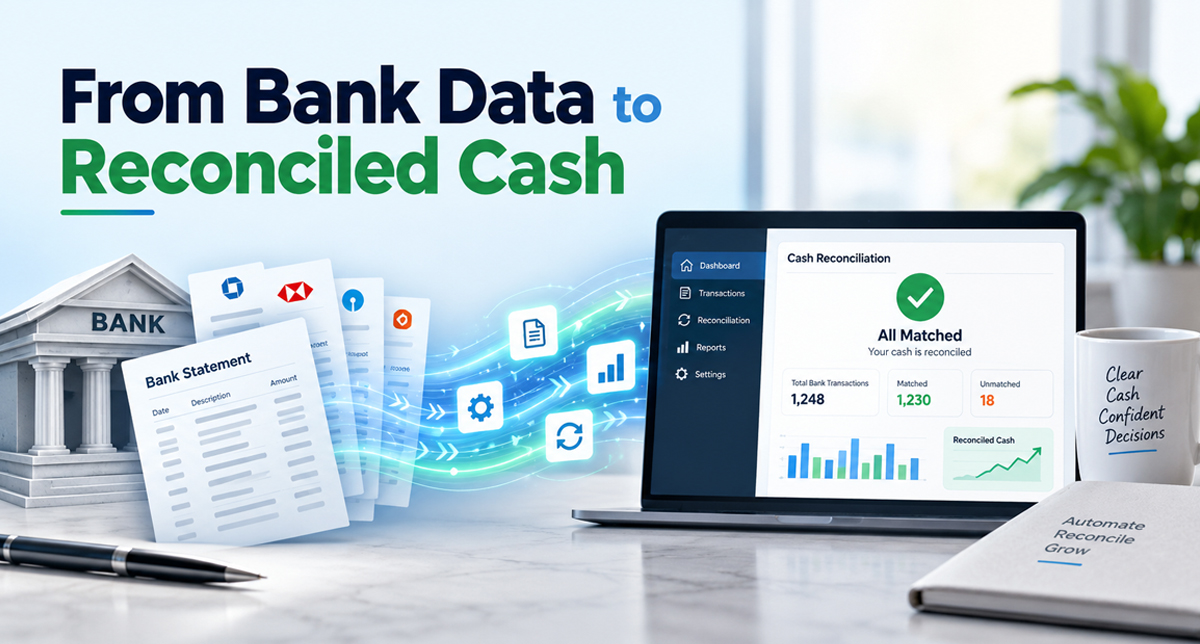
A well-designed bank statement automation model establishes a controlled route for files to move from the bank into Dynamics 365 Finance. The connectivity layer retrieves approved statement files, applies bank-specific configuration, identifies the correct files, initiates scheduled imports and archives processed files. Dynamics 365 then applies the organization's configured reconciliation rules and reviews.
| Capability layer | Primary responsibility | Business value |
|---|---|---|
| Bank connectivity | Secure retrieval, connection configuration, scheduling, file identification and archiving | Reduces manual handoffs and creates a repeatable statement-delivery process |
| Dynamics 365 Finance | Statement processing, matching rules, voucher creation, review, exception handling and reconciliation | Applies financial controls and supports structured investigation and approval |
| Finance operating model | Ownership, review, exception resolution, evidence retention and performance monitoring | Sustains control, accountability and continuous improvement |
Automation Should Redirect Work, Not Conceal It
The goal of automation should not be a blanket promise of zero-touch reconciliation. Banks use different statement structures, organizations configure different matching rules and some transactions will always require investigation. The stronger objective is controlled straight-through processing for suitable transactions, combined with visible and well-governed exception management.
This approach improves the quality of finance work. Routine movements can proceed through predefined rules, while analysts focus on unmatched receipts, bank charges, interest, direct debits, disputed items and transactions that fall outside approved tolerances.
Four Principles for a Scalable Approach
1. Standardize the intake
Define approved statement formats, file naming, bank-account mapping, retrieval schedules and archive rules before expanding automation.
2. Secure the connection
Align authentication, encryption, access control and credential ownership with the organization's security policies and each participating bank's capabilities.
3. Operationalize exceptions
Establish who reviews unmatched items, what evidence is required, when review has to be done and how unresolved transactions are escalated.
4. Govern change
Treat new banks, accounts, formats and matching rules as controlled changes. Test them, document them and monitor their effect on reconciliation outcomes.
What Finance Leaders Should Expect
A successful program can improve several dimensions of finance performance without relying on exaggerated automation claims.
- More timely availability of bank statement data in Dynamics 365 Finance
- Less reliance on portal downloads, local file handling and repeated uploads
- More consistent execution across bank accounts and participating banks
- Better traceability through controlled imports, archives and review
- Faster concentration on exceptions instead of routine transaction handling
- A reusable framework that can be adapted as banking relationships evolve for any new bank account
The actual outcome will depend on transaction patterns, statement quality, matching-rule design, bank participation, security requirements and the organization's willingness to standardize its process.
A Practical Bank-to-Reconciliation Journey
Five Questions to Ask Before Investing
Organizations should resist selecting technology before defining the operating conditions the technology must support. Five questions provide a useful starting point.
- Which banks, accounts, legal entities and currencies are in scope, and which should be prioritized?
- What statement formats and secure connectivity methods can each bank support?
- Which transaction fields are reliable enough to drive matching rules?
- How are bank charges, interest, direct debits, unidentified receipts and disputed transactions handled today?
- What review, segregation-of-duties and audit-evidence requirements must remain in place?
These questions expose the difference between a technical connection and an operable finance process. They also help establish a realistic roadmap, starting with the accounts and transaction patterns most suitable for automation.
Where Brightpoint Adds Value
Brightpoint Infotech helps organizations bridge the operational gap between participating banks and Microsoft Dynamics 365 Finance. Its approach combines bank-specific connection configuration and automated statement retrieval with the design and configuration of the downstream Dynamics 365 reconciliation process.
The connectivity framework can support secure file transfer, scheduled retrieval, filename controls, import initiation and processed-file archiving, subject to the participating bank's formats, security requirements and technical capabilities. Brightpoint then works with finance teams to configure matching logic, exception handling, review and the target operating model in Dynamics 365 Finance.
This is an important boundary: Microsoft provides the core reconciliation capability, while Brightpoint's differentiated value lies in making the bank-to-ERP flow operational, adaptable and aligned with the customer's finance controls.
The Executive Decision
Bank statement automation should be assessed as a finance transformation initiative with an integration component, not as an integration project with a finance afterthought. The technology must support the operating model, and the operating model must define where automation ends and accountable review begins.
Organizations that make this distinction can create a more sustainable path from bank data to reconciled cash positions. They can reduce avoidable handling while preserving the control, transparency and judgment that finance requires.
Assess Your Bank Integration Readiness
If your finance team is still downloading bank statements, moving files between systems or spending significant time preparing data before reconciliation begins, the next step is to assess the operating model before selecting a solution.
Brightpoint's Bank Integration Readiness Assessment is a focused 30-minute working session for organizations using or planning to use Microsoft Dynamics 365 Finance.
The Assessment Reviews
- Banks, accounts, legal entities, currencies and transaction volumes
- Available statement formats and secure connectivity options
- Current download, upload, reconciliation and exception reviews
- Matching fields, transaction patterns and automation opportunities
- Security, approval, segregation-of-duties and audit requirements
- Implementation dependencies, risks and recommended priorities
What You Receive
- An initial readiness view of your bank-to-Dynamics 365 process
- A prioritized list of automation opportunities and dependencies
- Recommended next steps for a scoped technical and finance workshop
Speak with Brightpoint Infotech to evaluate where automation can reduce manual statement handling, strengthen control and improve the reconciliation process in Microsoft Dynamics 365 Finance.
Book My Assessment